

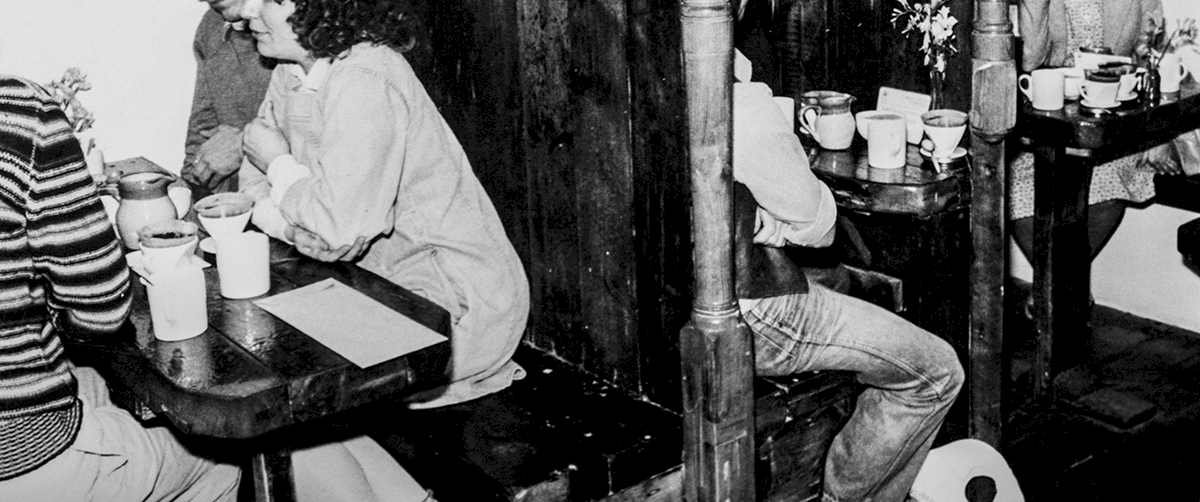
We’ve been making filter coffee at Monmouth since 1978. When we opened our first shop on Monmouth Street, the upstairs section was originally designed to be a tasting room where customers who were buying beans and ground coffee could try the different coffees we sold before making their selection. We needed a fairly quick sampling method, one which had a neutral impact on flavour, was easily repeatable in the shop, and didn’t require much specialist equipment. Single-cup, pour-over filter was the obvious choice.
In those first few weeks of opening, the tasting room became a space where our customers wanted to stay for a cup of coffee. We brought in pastries and a few other bits and pieces, and the café side of our business evolved. For our brew method we used Melitta style ceramic cones initially, then had them made for us by a local ceramicist, and then we found a supplier in Japan (Kenji) who could make the cones to our specification and supply us with enough of them that we could sell them in our shops. Our customers, often trying our single-cup method for the first time, enjoyed the process and wanted to buy the cones to take home. The cones we use now are still made at the Kenji factory in Japan and are still hand finished. We also have travel-friendly plastic cones – these are made by Melitta. The contraption in our shops which suspends the cones above the cups is called a filter rack, it was designed by Bob and manufactured for us by a local stainless-steel fabricator.
One of the key features of single-cup pour-over filter is how straight forward the brew method is, and for the curious amongst us, how infinitely variable it is as well. If one wants to learn about brew ratios (the amount of ground coffee versus the amount of water), or the effects of grind size on extraction, or in fact any variable that impacts the development of flavour in the cup (water temperature, water hardness etc), the filter method is pretty much the best method from which to learn. As a bonus it’s really difficult to get it so wrong that you can’t get some kind of coffee from it and lessons learned from this brew method can be applied to the others.
We have our own brew recipe which we use for making coffee in our shops for sampling, drinking, and for the counter tastings we do as a team. We use the same method in our roastery where every morning the roasters taste the previous day’s production, and it’s the way we brew when writing the tasting notes you see on our coffee lists. Our brew recipe has changed over the years and will continue to do so; with the amount of coffee used and the way we pour the water being the two variables which are subjected to the most tinkering.
But perhaps, with respect to the above, the best aspect of single-cup pour-over is that you (the reader) can discover just exactly how you really like your coffee. It is a highly customizable brew method – if you like your coffee a bit stronger, just add more ground coffee; if you like it a bit weaker, use less coffee. Whichever way you like your coffee don’t worry about it, just brew to how you like it to taste – it’s your coffee after all. Filter coffee can be as complicated or as simple as you want it to be, and fun is to be found across the full range of possibilities.
Monmouth x